Odor Organ
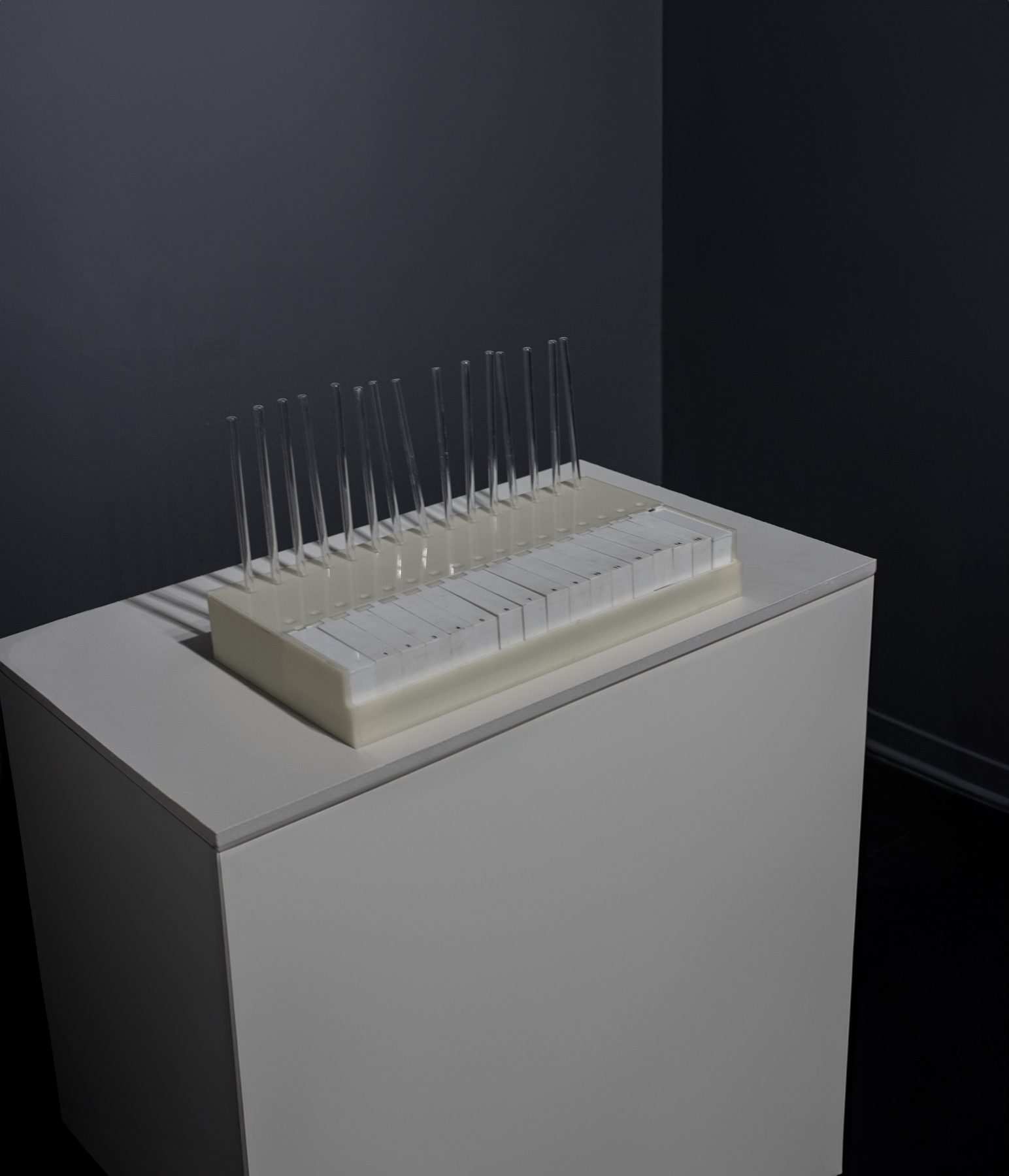
Modeled after the form of a keyboard, this compact device allows individuals to “play” scents instead of sounds. Each of its 15 keys pneumatically releases a specific odor.
- Years
- 2022 (prototype) to present
- Medium
- Air pump, tabletop device, fragrance materials
- Size
- 20 × 20 × 36 in with pedestal (approx.)
- Engineering
- Dan Gross, scientific engineer
- Accords
- George Tedder (IFF) and M Dougherty
- Materials
- International Flavors and Fragrances Inc., with Travis Aikman
About the work
As a society, our relationship with scent is profoundly fragmented. Scent weaves through every moment of our lives, forming an integral yet often unacknowledged aspect of our experience. Rarely is scent recognized as a sensory medium with structural, temporal, and malleable dimensions.
The Odor Organ was conceived as a tool to reintegrate scent into our cultural and intellectual consciousness as a dynamic and deliberate medium of exploration. It invites participants to encounter scent as both an unpredictable, organic phenomenon and a product of intentional design.
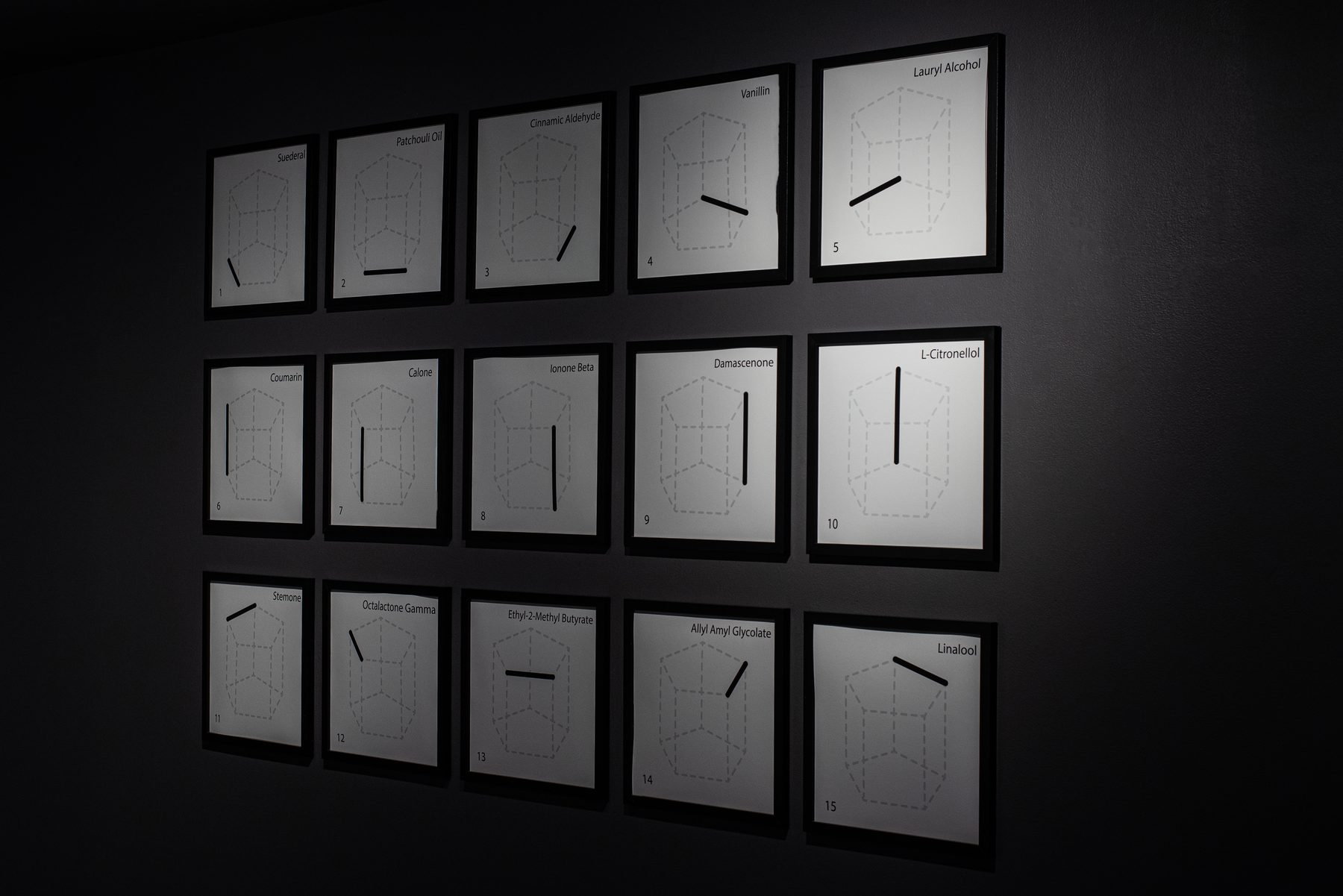
At its core, the Odor Organ bridges scent with sound through a notation system that transforms fleeting olfactory experiences into visible, comprehensible forms. The system's structure is inspired by a pentagonal prism, with each material corresponding to an edge. Combinations of materials, accords, create accumulations of edges, forming distinct geometric symbols.
Try it
Press keys to add materials, or choose an accord, and watch the edges of the prism build its symbol.
Accords
A model of the instrument's notation, in which each of the fifteen materials is an edge of a pentagonal prism. It shows the symbols and does not release scent.
Materials
Developed with perfumer George Tedder, the palette balances synthetic molecules, natural isolates, and traditional perfumery staples. Allyl Amyl Glycolate, which evokes pineapple, allows for accords such as petrochemical smells. Patchouli Oil anchors the system in traditional olfactory practice.
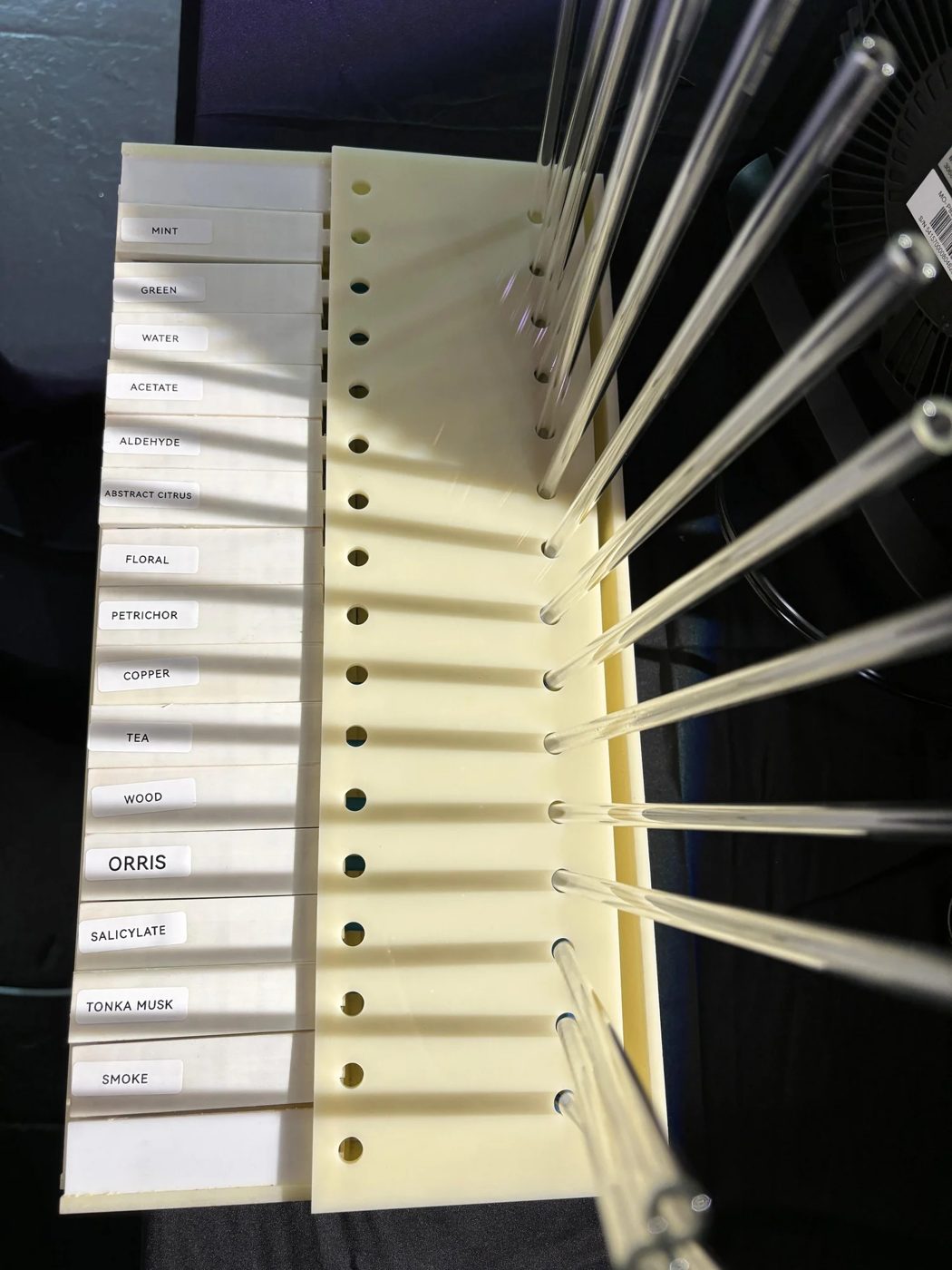
Classical accords (leather, chypre, amber, chai, rose, freesia, muguet, fougère, pineapple, fig) sit alongside experimental compositions such as milk, grass, and metal.
How it plays
- An ultra-quiet air compressor feeds fifteen channels through push-to-connect fittings.
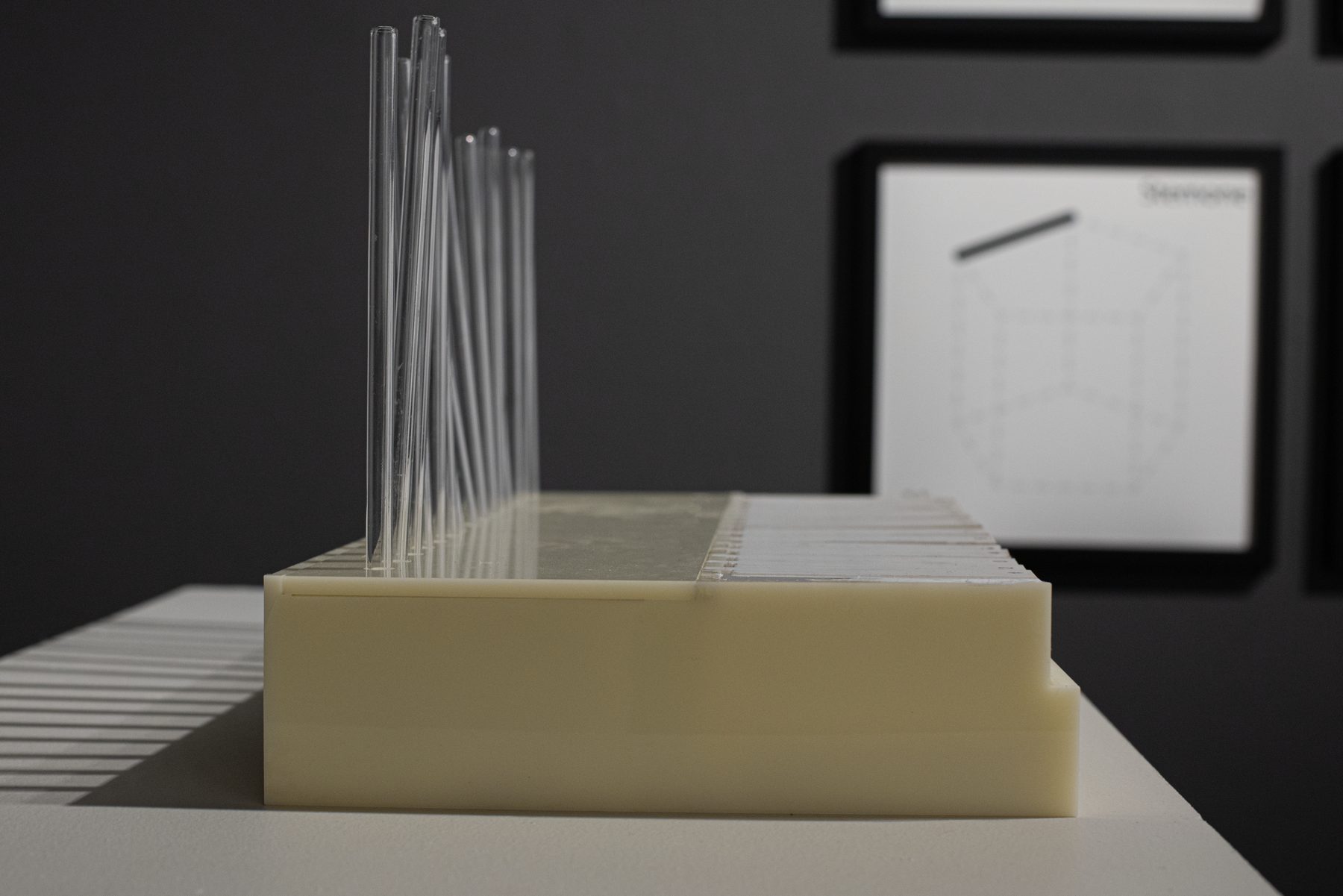
- Each channel runs to a plunger valve under a 3D-printed key. The note sounds only while the key is held.
- Air passes through a cartridge whose absorbent core holds the odorant, diluted in ethanol and dipropylene glycol.
- Scented air rises from a glass tube toward the player, who perceives the changes in the scentscape first and in the most detail.
Three ways to play
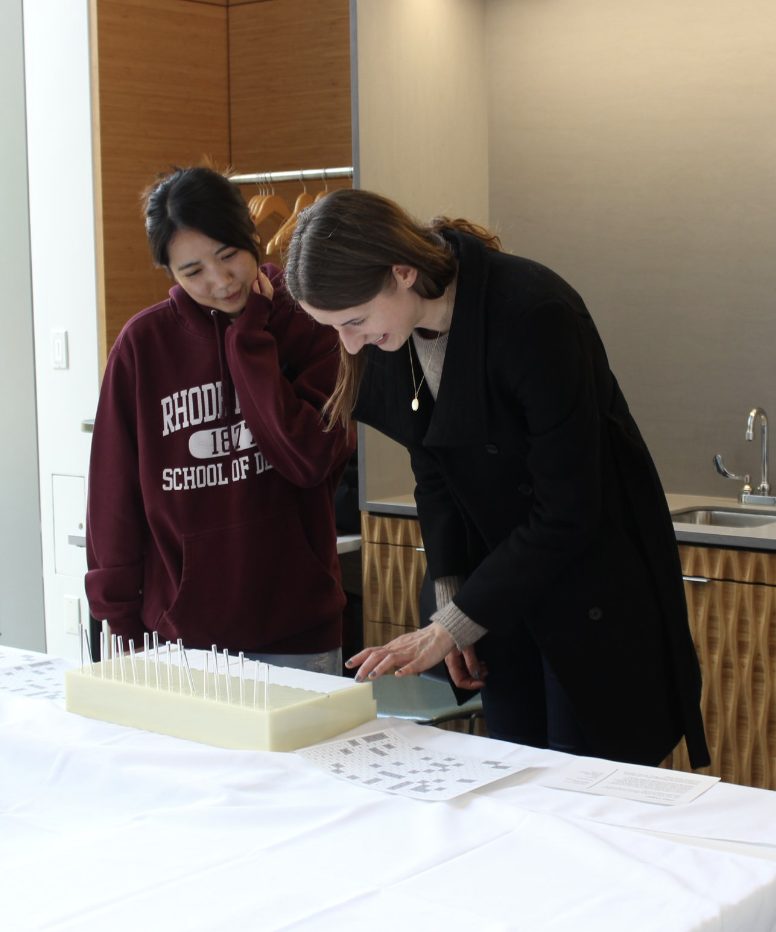
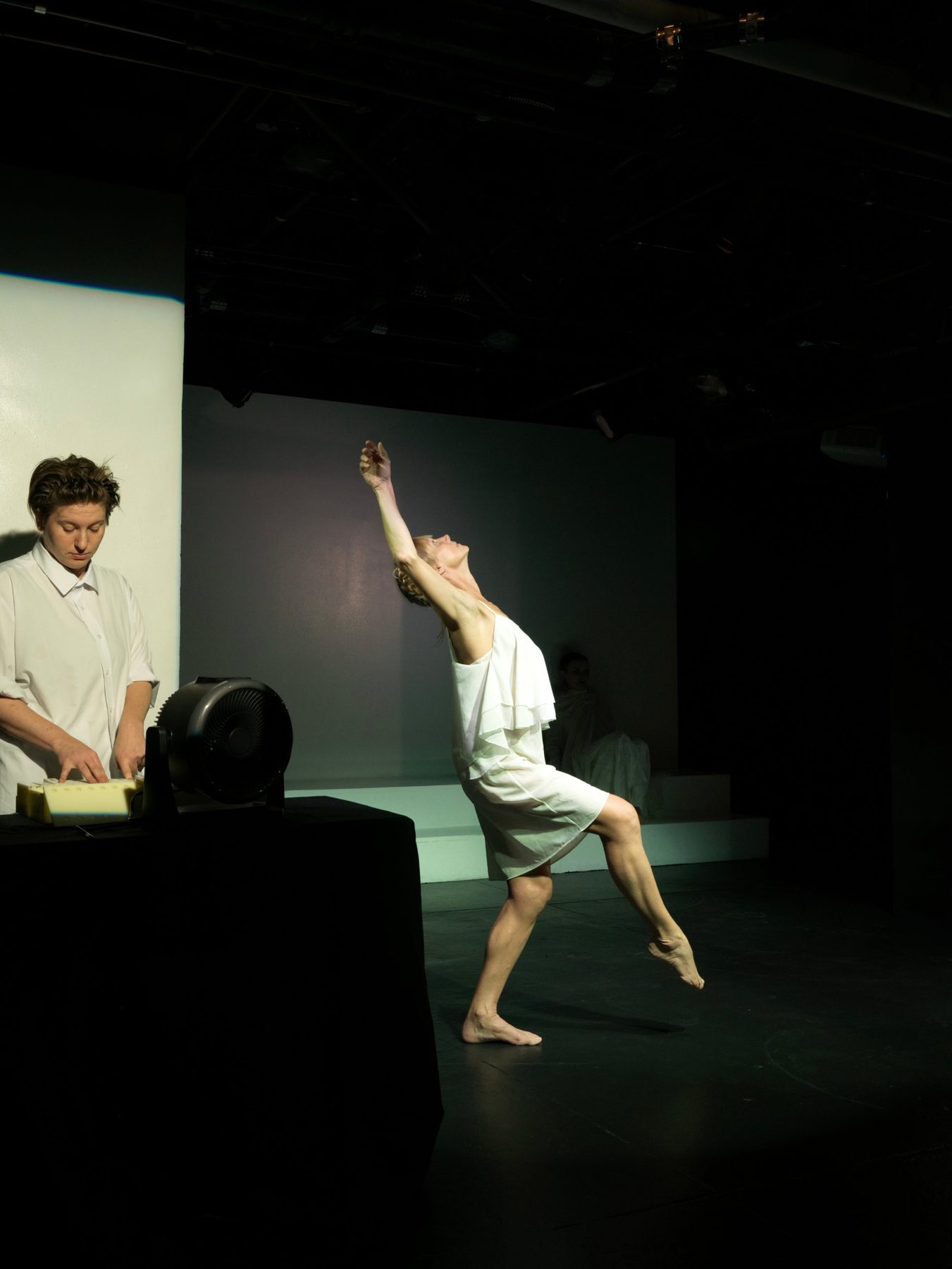
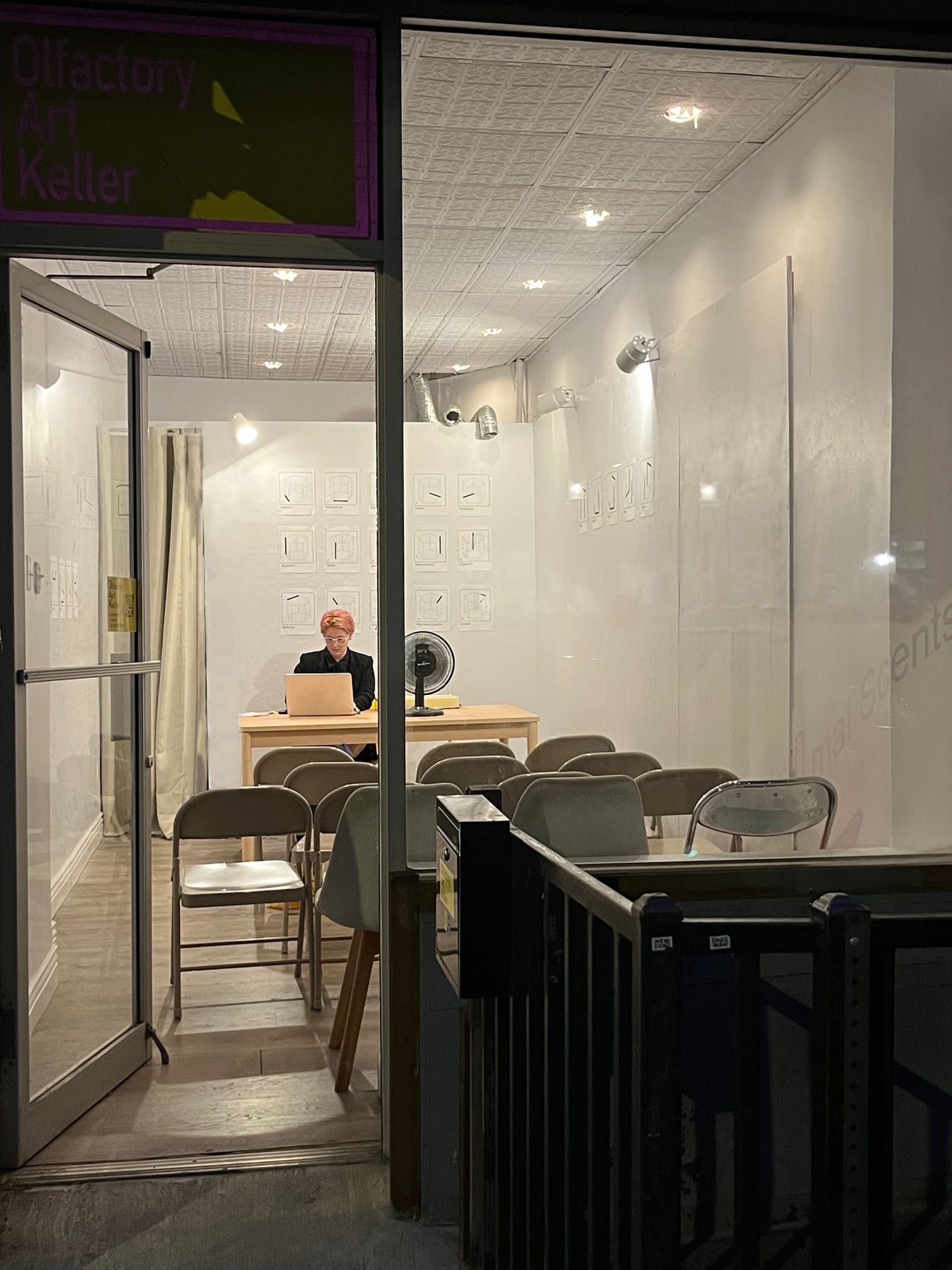
Lineage
Septimus Piesse mapped scents to the notes of a piano. In 1922, artist Frank R. Paul illustrated a theoretical smell organ that was never fabricated. Aldous Huxley's Brave New World imagined a scent-organ playing a "Herbal Capriccio." Unlike scent organs built for an audience of many, the Odor Organ is optimized for the player.
Shown at
- 2025Sensory Symphony, open rehearsal and artist discussion with Muriel Louveau (voice) and Emily Pope (movement), 106th Performance Space, New York
- 2025Ether: Aromatic Mythologies, Odor Organ and notational system, curated by Saskia Wilson-Brown, Craft Contemporary, Los Angeles
- 2023Gateways to Awareness, New Bedford Art Museum, New Bedford, MA
- 2023Noseum, OSMOCOSM, MIT, Cambridge, MA
- 2023Associations: Symphonic Ephemera, sold-out performance, Olfactory Art Keller, New York
- 2023Scentience: A Collection of Olfactory Expressions, solo, Boston University
- 2022Odor Organ: Device Design for Olfactory Education, talk, OSMOCOSM
- 2022Odor Organ (prototype), New York University
Press
- 2026“Sensory Symphony: Exploring the Interplay of Scent, Voice, and Movement”, text by M Dougherty, Sensum vol. 1, issue 1
- 2025“Craft Contemporary opens new scent-based exhibitions”, Edwin Folven, Beverly Press
- 2024“64. Scented Reliquary”, Screenshot Reliquary, on Symphonic Ephemera
- 2023“NBAM's year-end exhibit inventive, eclectic and engaging”, The New Bedford Light
- 2023“You must smell the Odor Organ at the New Bedford Art Museum”, Arts House Magazine
- 2023“Olfactory Art Keller Presents Associations Series”, Perfumer & Flavorist
- 2023“M Dougherty, Low Res Alum, Presents Symphonic Ephemera”, NYU ITP